
Thousands of encounters between researchers and the public, classrooms bursting with questions, and countless exciting hands-on experiments. ForskarFredag 2025, Sweden’s Researcher’s Night, once again proved that curiosity knows no age and no geographic bounds. More than 26,000 people across the country took part, meeting scientists, trying new activities, and discovering the world of research in new and surprising ways.
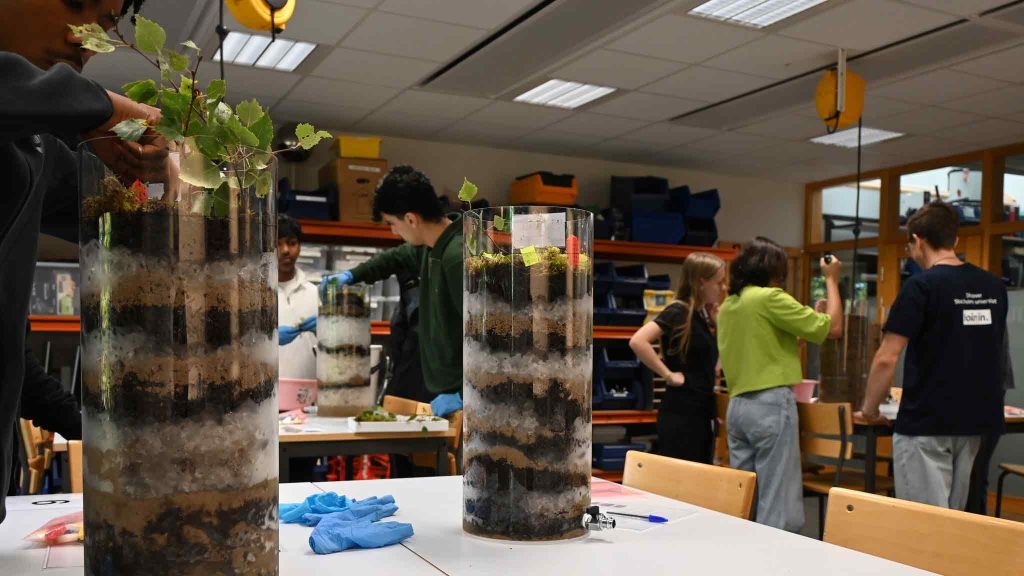
The theme ”The Earth beneath our feet” was explored in a variety of ways. During ForskarFredag in Stockholm, participants were able to investigate how permafrost works during a full-day workshop. Photo: Vetenskapens Hus
This year’s theme, “The Earth Beneath Our Feet,” inspired a rich programme filled with exciting talks, workshops, and demonstrations. In addition, around 8,500 pupils participated in the researchers at schools initiative, Borrow a Researcher, which connects pupils with researchers either in the classroom or online. In total, 550 researchers contributed to ForskarFredag 2025, which ran from 22-27 September as part of the European science festival European Researchers’ Night.
Science cafés, a science relay race, a genius blitz fair, shows, a science breakfast, science after work, guided tours and much, much more were all part of the festival programme, which consisted of more than 100 activities. Take a look at some of them below!
Climate models and the cities of the future
At SMHI’s headquarters in Norrköping, visitors gathered for an interactive presentation on climate research, learning how climate models work and how SMHI contributes to national and international research projects.
On stage were researchers Renate Wilcke, Petter Lind, Yi-Chi Wang, Gustav Strandberg, Joakim Kjellsson, Nikki Brown, and Iréne Lake, while Miranda Gatti Ståhl and Lindha Nilsson hosted the event. During the break, visitors could take part in a climate-themed quiz walk developed within the OptimESM project, which is used by students across Europe.
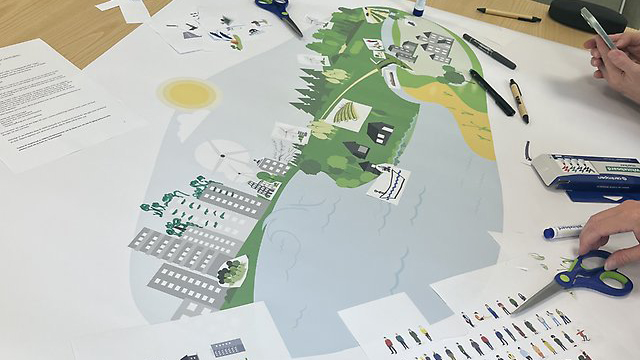
In the afternoon, the workshop Future Visions invited participants to paint their own ideas of climate-adapted societies. “It was truly fun to meet such an engaged audience. We’ve received a lot of positive feedback and already a request to visit a folk high school. Researcher’s Night is a fantastic opportunity to show how research is conducted and, hopefully, inspire the next generation of climate researchers,” says Miranda Gatti Ståhl.
During the week, three SMHI researchers also took part in Borrow a Researcher. One of them, climate researcher Klaus Wyser, described his school visits as rewarding. “It was an exciting experience, both for me and for the pupils. It was great to be able to share the natural science, physics, and mathematics behind climate scenarios.”
Why do research?
At Södertörn University, upper secondary and folk high school students from the Stockholm region gathered to learn more about how research is conducted – and why it matters. “The idea behind Researcher’s Night is to show how research affects our everyday lives and how researchers work to understand and change the world,” said Anna Högberg, educational specialist and one of the organisers.
One programme highlight that sparked great interest and engagement was the Swedish Red Cross presentation on research into refugees’ mental health. Petter Tinghög, a researcher in social epidemiology, explained how housing conditions during the asylum process can affect people’s mental health and well-being, even much later in life. “It was interesting to see how the research that becomes news on SVT is actually done,” said Alexander Olsson Illhammar from Stadsmissionens Folk High School.
A recurring favourite was the tick workshop led by Thérese Janzén. Pupils observed ticks under microscopes, learned how they spread diseases, and how to remove them properly. She also explained how climate change may affect tick populations – and thus public health.
“It was interesting to see how much different research there is. We just met a professor of literary studies, and now ticks,” said Amanda Shawket from Huddinge Upper Secondary School. Not everyone was as equally fond of the tiny creatures – “pretty gross and scary” was a common reaction – but curiosity still won out, and the questions kept coming.
Soil, wind, and water
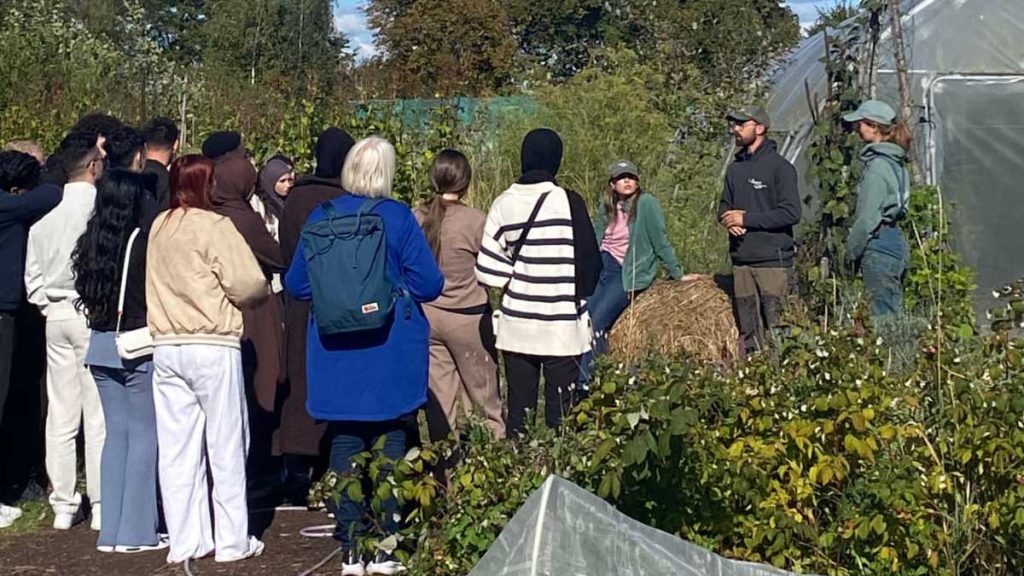
At Alnarp’s Agroecology Farm, upper secondary students were able to experience natural science in action. Through experiments and studies of minerals, air quality, and microorganisms, pupils explored soil as a living system essential for food production, biodiversity, and climate balance. The activities were organised as part of the EU project LOESS, which aims to raise awareness of soil health across Europe.
Audible Ants, VR, and Sensory Sensations
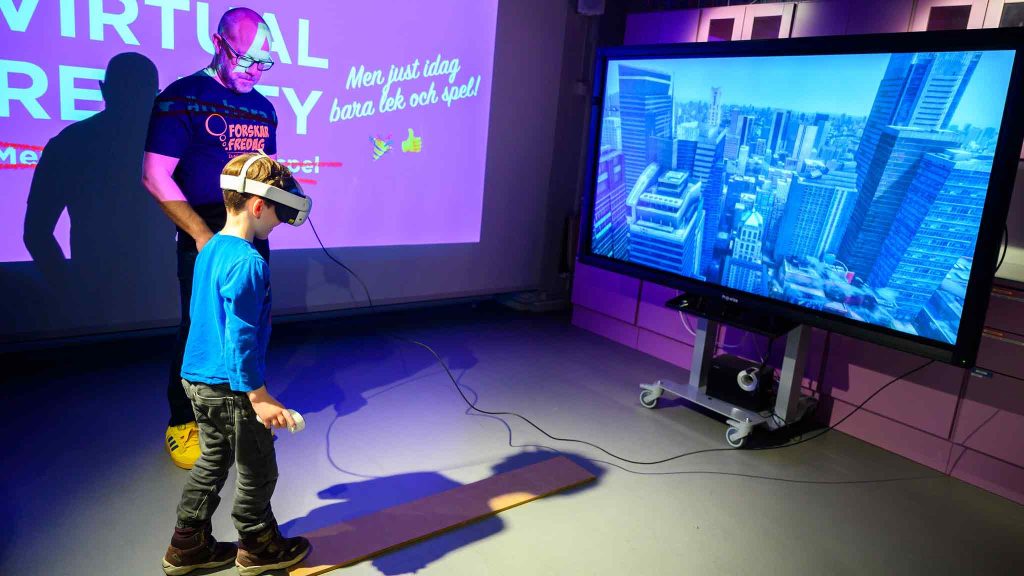
At Umeå University, the Faculty of Social Sciences transformed a large room into a vibrant collection of interactive stations. Anders Lundström and Magnus Mikaelsson demonstrated how VR technology can treat phobias, with long queues forming for the virtual plank walk atop a skyscraper. Psychology researcher Linus Andersson invited visitors to test their sense of smell, eat their favorite sweets, and watch their brain activity live via a sensor-equipped cap – a playful introduction to how the brain responds in different situations.
With Louise Vang Sørensen from the Department of Ecology, Environment, and Geoscience, visitors could listen to life inside an anthill. Using contact microphones placed in the soil, she studies the sounds made by earthworms and ants to determine whether they differ depending on soil quality. “Ants and earthworms make a surprising amount of noise, which is fascinating because they aren’t animals we usually listen to. Sound can give us a lot of information about the world around us, and we want to show why it’s important that we listen,” she explained.
Researchers visited 300 school classes
During 2025, researchers met pupils in both April and September through school visits held on-site and remotely. In total, 300 visits were carried out as part of Borrow a Researcher, during which researchers talked about their fields and answered pupils’ questions about everything from how to become a researcher to how much a researcher earns.
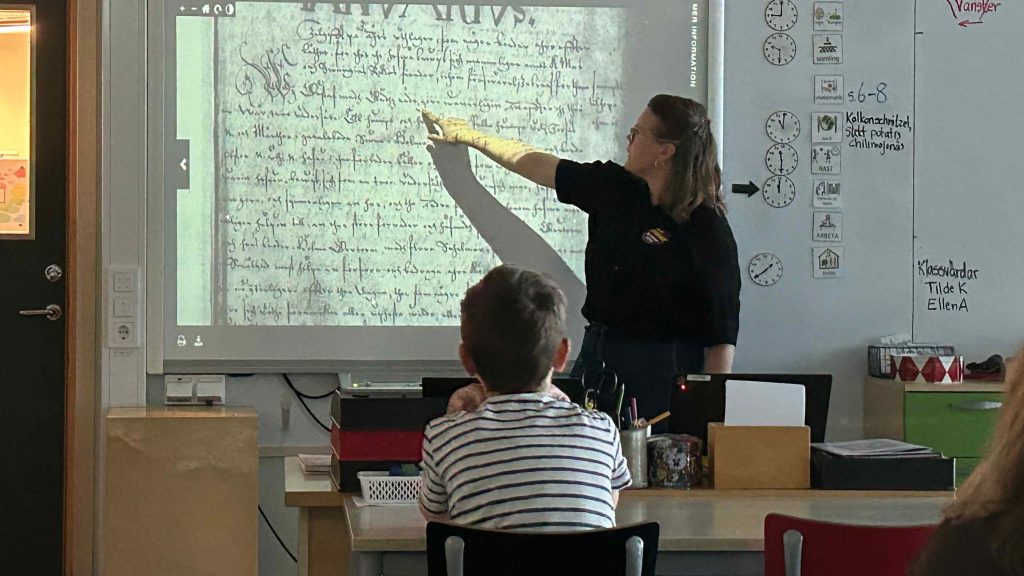
One of the researchers was Lisa-Maria Cambladh who is doing her PhD in history. She visited a school located right in the geographical area she studies in her research on 17th-century society and road construction.
“Look at this old map – do you recognise where you are? Here by Flottsbro, the road from Huddinge to Stockholm ran back then. It’s a ski slope today: do you think it was easy to drive a horse carriage uphill? It wasn’t, and it was decided that they needed to construct a new road” she told the third-grade pupils at Utsälje school.
The pupils learned that protests from a landowning nobleman eventually pushed the king to enact a new law to actually build the road. Their questions quickly grew beyond history itself: How do we actually know what things were like in the past? What is a source? How can you research something that happened several hundred years ago?
Discussions about sources and critical thinking were a red thread throughout the session. Lisa-Maria showed old maps and documents from the Swedish National Archives, which the pupils tried to interpret themselves. One highlight was examining letters from the Riksregistraturen – royal correspondence preserved to this day.
When the session had come to an end, several curious pupils returned to ask where they could find more old documents. Perhaps a future historian was among them? “I didn’t think you were going to talk about roads, but it was fun!” one pupil said. “If I were to do research, it would probably be about horses,” added another.
ForskarFredag 20 years – towards the future
Next year, ForskarFredag celebrates its 20th anniversary! We will be marking the occasion in grand style and hope you will join us. Over the years, countless exciting research projects have been presented – and there are many more to come. Because the wonderful thing about our world is that it always offers more to discover.
ForskarFredag is part of the European collaboration European Researchers’ Night and Researchers at Schools. This year, Researchers’ Night activities were run in 25 countries and are expected to have reached over 1.5 million people.
The ForskarFredag 2025 science festival was carried out with support from the Carl Tryggers Foundation; the Royal Swedish Academy of Letters, History and Antiquities; the Oscar and Maria Ekman Donation Fund; SULF – the Swedish Association of University Teachers and Researchers; the Wennergren Foundations; Naturvetarna; the Swedish Research Council; Åforsk; and the EU’s research and innovation programme Horizon Europe through Marie Skłodowska-Curie Actions, GA 101061464.
