
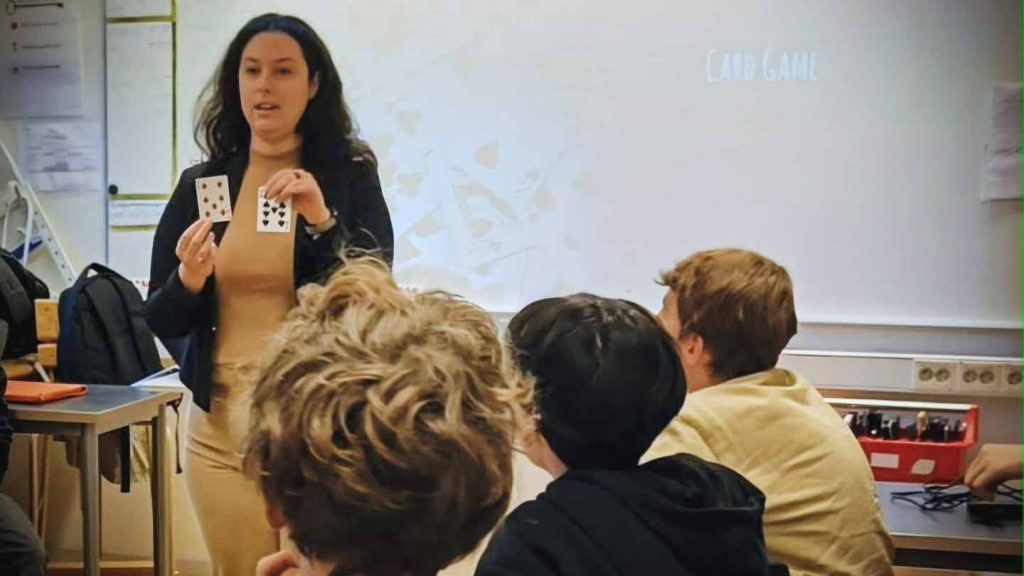
Last year, I participated in Borrow a Researcher for the first time. Talking to teenagers made me nervous, but it turned out to be one of my best science communication experiences. Now, nearly a year later, I want to share why I think you should consider participating as well and how to make your visit a successful one.
Why You Should Consider It
When I think about science communication, I remember Neil deGrasse Tyson. When asked in an interview why he communicates science, he said something in the lines of: Because I can. That stuck with me. He meant many scientists struggle to share knowledge understandably. Most of us have had a brilliant teacher or professor who, despite expertise, struggled to make the subject accessible.
Borrow A Researcher offers a fantastic opportunity to experiment with science communication within a supportive environment. It allows you to discover whether you enjoy it, whether it’s rewarding, and whether your message lands. You’ll receive feedback almost immediately from both students and teachers. Communication is one of the most versatile transferable skills, helping you explain your research more clearly, craft stronger grant applications, and ultimately become a better colleague and mentor.
There is also the well‑known idea that “the best way to learn is to teach.” Many of us only really understood a subject or a research result once we tried to explain it to someone else. You are in the midst of explaining it and suddenly, puff… It’s so obvious!
My fellow programmers will recognise the value of the rubber duck: explaining your problem out loud so your brain can solve it. Explaining your research to students, often young and unfamiliar with research, forces you to distil your message to its core. You quickly realise what matters, what doesn’t, and which questions are truly fundamental.
Finally, this experience can inform your research. Students ask simple yet brilliant questions or connect topics to real-world experiences. In health or biology, this can spark new ideas or research directions.
What You Can Do to Make Your Visit Successful
Before applying on the portal
- Consider one or two topics you are comfortable discussing, as schools will select you based on these.
- Mark all the time slots when you are genuinely available, since they can fill up quickly.
- Allow sufficient time between visits in case schools are located far apart.
After a teacher books a visit with you
- Schedule a brief online meeting with the teacher beforehand to discuss:
- The students’ age and prior knowledge
- What aspects of the topic interest them most
- Practical details such as available time, projector, board, computers, etc.
- Rehearse your presentation or activity with someone outside academia. Ask for their feedback:
- What they understood
- Their main takeaway message
- Always allocate more time than expected to account for delays. Expect travel holdups, technical problems, or enthusiastic questions. Prepare:
- A concise core activity
- A supplementary activity if time permits
These ensure flexibility and the optimal use of available time.
- Save interactive or group activities for the end, but absolutely do them. Students are more engaged and retain more when they participate actively. Just be warned: once they’re excited and involved, it’s very hard to return to a lecture-style format!
I hope these tips boost your confidence and inspire you to join this year’s Borrow A Researcher. Vetenskap & Allmänhet offers great resources to guide you. And feel free to contact me about my experience.
If you would like to read further, I also wrote a blog talking about what I learned at the time, you can read it here.
Happy communicating!
Until we meet again,
Alana
Alana de Castro Panzenhagen is a Postdoctoral Researcher at Karolinska Institutet. She has a PhD in Biochemistry and her current research focuses on molecular biology of cancer.
