
Public confidence in research in Sweden remains strong, and a majority of Swedish voters want research to play a greater role in politics. These are among the key findings of the Swedish Science Barometer 2025/26, conducted by the non-profit association Public & Science Sweden.
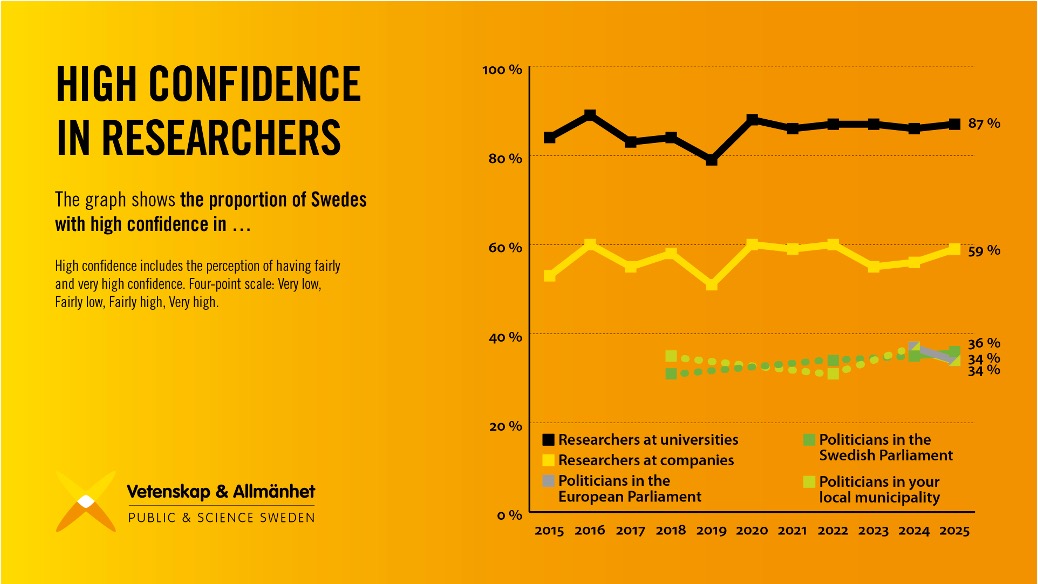
As in previous years, the Swedish public’s confidence in research and researchers is high. Almost nine in ten (87 percent) report a high level of confidence in researchers at universities, while eight in ten (79 percent) express high confidence in research in general.
Research and politics remain in focus
Like last year, the 2025/26 Science Barometer has a particular focus on the relationship between science and politics. This allows trends in public attitudes to evidence-informed decision-making to be followed over time, and provides insight into how Swedes view researchers’ role in public debate in the run-up to the 2026 Swedish general election.
As in the previous year, almost half of Swedes believe that politicians in the parties they themselves support give the right amount of consideration to research findings. At the same time, many feel that politicians in general pay too little attention to research. A large majority also believe that researchers should express their views on political issues related to their areas of expertise, which many argue leads to better policy-making.
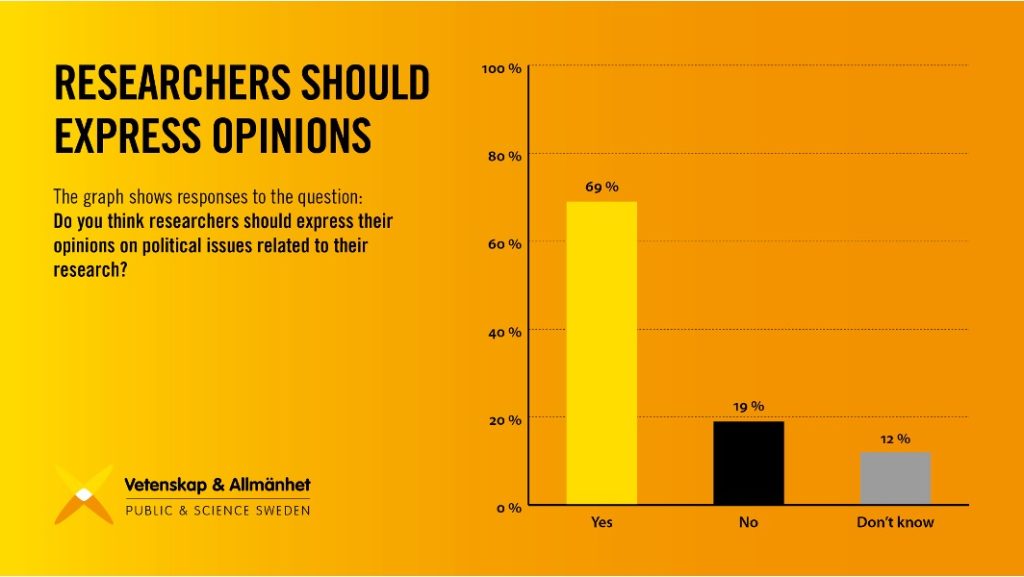
“This is a clear signal to politicians that voters are calling for decisions grounded in research. The results also show that researchers are expected to take part in public debate and contribute to more evidence-informed policy,” says Ulrika Björkstén, Secretary-General of Public & Science Sweden.
Greater confidence among opposition voters
Confidence in researchers’ statements varies across different fields of research. Swedes express the highest confidence in statements from researchers in the natural sciences, medicine and engineering. Confidence is lower when it comes to statements on social science-related issues such as integration, teaching methods in schools, crime and gender identity.
“We see that confidence in natural scientists is high among voters in both political blocs. Among opposition voters, however, confidence is generally higher than among supporters of the governing coalition, especially in certain areas linked to the social sciences,” says Åsa Johansson Palmkvist, a researcher at Public & Science Sweden.
Young people’s confidence back at a high level
Last year’s survey showed a sharp decline in confidence among the youngest age group (16–29 years), with 66 percent reporting high confidence in research. In the 2025/26 survey, the figure has increased to 80 percent, in line with the long-term pattern for this age group.
“The decline in confidence seen last year among the youngest respondents therefore appears to have been temporary, and may be linked to the relatively small sample size,” says Åsa Johansson Palmkvist.
Download and read the 2025/26 Science Barometer here!
The results of the Swedish Science Barometer 2025/26 are based on 1,014 telephone interviews with a random sample of Sweden’s population aged 16–74 years, representative in terms of gender, age and place of residence. The interviews were conducted between 11 August and 28 September 2025. This is the 24th survey carried out since the non-profit association Public & Science Sweden was founded in 2002.
