
Freedom of expression and academic freedom were central themes when Public & Science’s Secretary-General, Ulrika Björkstén, took part in UNESCO’s General Conference in Samarkand, serving as an advisor within the Swedish delegation.
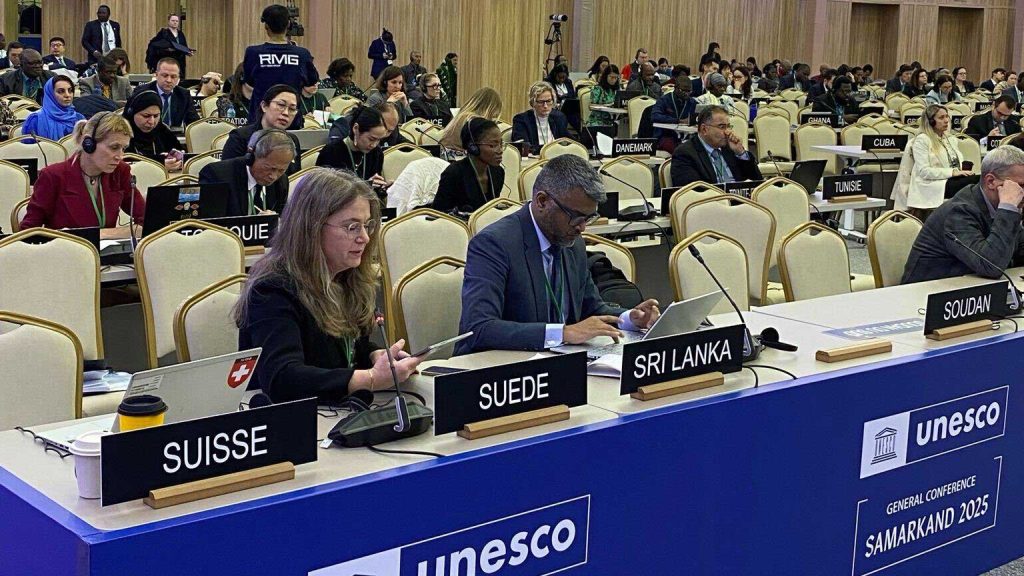
UNESCO’s 43rd General Conference took place in Samarkand, Uzbekistan, from 30 October to 13 November. It was the first time in 40 years that the conference had been held away from UNESCO’s headquarters in Paris.
The General Conference gathers representatives of UNESCO’s Member States and Associate Members, observers from non-member states, international intergovernmental organisations and non-governmental organisations. Sweden’s delegation included representatives from the Ministry of Education, public agencies and civil society:
- Journalistförbundet (Swedish Union of Journalists)
- KLYS – The Swedish Joint Committee for Artistic and Literary Professionals
- The Swedish National Commission for UNESCO
- Sweden’s Delegation to the OECD and UNESCO in Paris
- Sveriges Lärare (Teachers’ Union of Sweden)
- Ministry of Education
- Public & Science Sweden
The delegation was led by Oscar Wåglund Söderström, State Secretary at the Ministry of Education.
Ulrika Björkstén’s address at the conference
”Sweden commends UNESCOs work to promote and ensure academic freedom. We welcome the report on the implementation of the 2017 Recommendation on Science and Scientific Researchers. We note that many Member States stress the importance of Open Science, citizen involvement and access to research data.
Sweden would like to underline the role of independent academic research in sustainable and democratic societies, and we would like to see UNESCO continue its work to strengthen research systems by promoting high-quality research, interdisciplinary knowledge and open science.
We particularly want to stress that freedom of expression is an intrinsic part of academic freedom. Universities need to protect not only academic freedom inside academic institutions but also ensure the right of researchers and academic teachers to disseminate their results and insights in the public sphere. We therefore want to emphasise the need to create structures to protect researchers from harassment when they communicate their results in public and to safeguard researchers’ right to take part in public debate.
As is shown by the forthcoming UNESCO World Trends in Freedom of Expression and Media Global Report 2025, hostility towards environmental and climate researchers is growing, and scientists face harassment and pressure to downplay findings. As employers, universities need to give proper support to researchers who experience harassment. Female researchers are particular targets of harassment in the public sphere, and Sweden wants to see a UNESCO that works to combat all forms of discrimination and stereotypes, also in this field.
Thank you.”
Freedom of expression, hate and threats – reflections after the conference
After returning from the General Conference, Ulrika Björkstén appeared on P1 Kultur, a leading cultural affairs programme on Sweden’s national public radio broadcaster, Sveriges Radio. Together with Anna Herdenstam, Vice Chair of the Swedish Union of Journalists, they discussed the conference and UNESCO’s report World Trends in Freedom of Expression and Media Development.
The report highlights that climate and environmental researchers, like journalists, are increasingly subjected to threats, hate and harassment – with women researchers and journalists being particularly vulnerable.
“It is clear that academic freedom and freedom of expression are closely linked. Researchers who share their findings and speak out publicly are more exposed, and their statements are often fundamental to the work of science journalists,” said Ulrika Björkstén.
At the same time, the right to participate in scientific progress and to benefit from its results is enshrined in the UN Declaration of Human Rights.
“This is why UNESCO is committed to these questions and strengthens efforts that support researchers and journalists in its Member States,” explained Ulrika Björkstén.
