Citizen Science
Citizen science involves the public, i.e. people who are not researchers, helping researchers to investigate certain questions.
Why co-creation in research and citizen science?
There are several advantages to citizen science and co-created research. Perhaps the most obvious is that citizen science helps researchers to speed up scientific progress. In addition, citizen science can be a way of engaging people who would not otherwise come into contact with research. Citizens gain better knowledge of what research entails and how it is conducted, something that over time can increase their confidence in science, build relationships and create dialogue between researchers and society.
How do we work with Citizen Science?
Together with civil society, researchers, projects and international actors, we facilitate, plan and coach all stakeholders in co-creating through one or more steps in the research process. Are you interested in collaborating with us, holding a workshop or being part of an application for a citizen research project? Contact us!

What is Citizen Science?
Citizen science involves researchers co-creating with the public in some way during the research process.
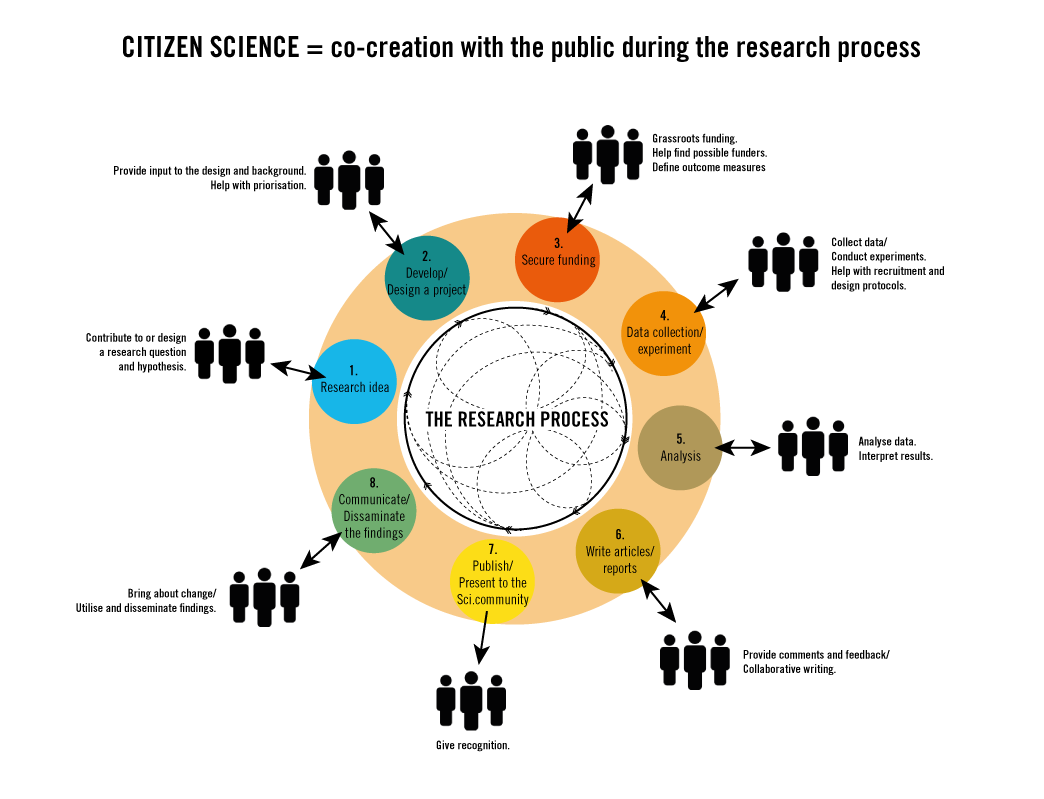
The most common way is by helping researchers to collect and/or review large amounts of data, on a scale that would be impossible for researchers to achieve on their own. This may involve, for example, reporting observations of plants or animals, transcribing old letters or classifying images of galaxies. Citizen science can also involve collaboratively formulating research questions, testing methods, and compiling or communicating findings.
The involvement of members of the public, patients and family members in research, public engagement and collaboration with different stakeholders in health research or health-related citizen science is often referred to as PPI, short for Patient and Public Involvement.
There is strong and growing interest in co-creation and public involvement in research. Co-creation in research, both as an approach and as a research method, is described using a wide range of terms. Research funders, for example, use concepts such as: Public engagement, Stakeholder involvement, Participatory action research, Citizen engagement, Community engagement, Citizen involvement, Patient and public involvement (PPI), Community-based participatory research, Public participation, Place-based public engagement, Patient and public involvement and Engagement (PPIE), End-user involvement, Citizen science, Civic engagement and Societal engagement….
This wide range of terminology reflects both the growing interest in co-creation and the diversity of research disciplines in which different co-creative approaches have emerged.
Further information:
- Wikipedia entry on citizen science
- The European Citizen Science Association’s 10 principles for citizen science