Swedish Researchers’ Night celebrates 20 years of curiosity and discovery
From experiments, science shows and guided tours to conversations with researchers, citizen science and visions of the future, ForskarFredag 2026 brought research closer to thousands of people across Sweden. This year was particularly special as Sweden’s European Researchers’ Night celebrated its 20th anniversary.
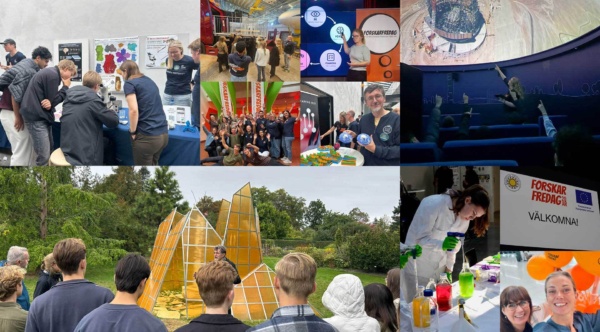
Between 21 and 26 September, activities took place in 25 locations from Luleå in the north to Lund in the south, as well as online. Visitors of all ages had opportunities to experiment, meet researchers, ask questions, and explore research across a wide range of disciplines.
The ForskarFredag festival is made possible by local organisers across Sweden, including universities, museums, science centres and other organisations that create activities and bring researchers and the public together in their own communities.
Looking 20 years into the future
This year’s anniversary theme invited participants to look ahead. Through Future Mission (Framtidsuppdraget), people were asked what they would like research to have discovered or achieved 20 years from now – and which of today’s problems they hope science will have helped to solve by 2046.
Their hopes covered everything from health and well-being to technology and sustainability. “In 20 years, I hope we will have come much further in tackling mental ill-health,” wrote one participant, who also hoped for faster access to support, less stigma and a better understanding of the causes.
Another wanted to see “an environmentally friendly and efficient way of cooling the computers used by AI data centres”, while another hoped that “in 20 years there will be more medicines and new ways of treating diseases such as cancer”.
New ways to meet researchers
Some of this year’s activities took research into unexpected settings.
In Linköping, decision researchers Gustav Tinghög and Daniel Västfjäll spent the day working and talking in a shop window, inviting passers-by to ask questions about research and life as a researcher. Their aim was to make research feel less mysterious and show more of the people behind it.
Elsewhere, thousands of pupils joined the Swedish Museum of Natural History’s digital escape room, working together to solve challenges and puzzles created by museum researchers. The activity attracted around 6,000 registrations, most from school pupils taking part as part of their science lessons.
Across Sweden’s five WISDOME arenas, meanwhile, visitors joined a shared live programme in which three researchers took audiences on a journey through space and shared their visions of the future – from questions close to Earth to phenomena several light years away.
In Skellefteå, upper secondary pupils presented work developed in collaboration with researchers around five societal challenges identified for Society Expo 26: social sustainability, climate and environment, mobility, housing provision and skills development. The pupil groups chose which challenge to explore in greater depth, researched the issue and developed their own proposals for possible solutions. On ForskarFredag, they presented their ideas to an invited audience, with researchers there to hear the results.
Bringing research into the classroom
During ForskarFredag week, 53 researchers completed 130 visits to schools across Sweden through Borrow a Researcher, reaching around 4,120 pupils in person and online.
Researchers talked about their work, what it is like to be a researcher and the different routes that can lead to a career in research. One of this year’s participating researchers was behavioural scientist Amanda Rikner Martinsson from Örebro University, whose research focuses on young people’s climate anxiety. Ahead of her visits to upper secondary schools and folk high schools, she described the encounters as opportunities for mutual learning – giving her a chance to share research-based knowledge while also hearing pupils’ questions, perspectives and ideas.
Digging deeper into citizen science
More than 4,600 pupils in over 220 school classes registered for Dig Deeper, ForskarFredag’s 2026 citizen science project. Pupils collected soil samples from parks and urban green spaces across Sweden to help researchers investigate soil health and the biodiversity hidden beneath our feet.
The samples will contribute to research led by Tord Ranheim Sveen at the Swedish University of Agricultural Sciences (SLU), who is investigating how trees influence the biodiversity living in the soil beneath them.
“It is fantastic to get this much help collecting samples from across the whole country. I would never be able to do it by myself,” he says.
The project gave pupils first-hand experience of the research process while contributing data from locations across the country that would be difficult for researchers to collect alone.
Dig Deeper is organised by Public & Science Sweden within the EU-funded LOESS project and in collaboration with the Mission Soil project ECHO.
Twenty years of curiosity
For 20 years, ForskarFredag has brought researchers and the public together in schools, museums, science centres, universities and other settings across Sweden. While the topics and formats have evolved, the aim remains the same: to create dialogue, spark curiosity and make research a more visible part of society.
“Much has changed since ForskarFredag began 20 years ago, but there are still so many questions for us to explore together. This year, we wanted to look ahead and ask what challenges we hope research will have helped us solve in another 20 years – and what knowledge we will need to get there. That dialogue between researchers and society is really at the heart of ForskarFredag,” says Kjell Bolmgren, Coordinator of ForskarFredag at Public & Science Sweden.
ForskarFredag is part of the European collaboration European Researchers’ Night and Researchers at Schools. This year, European Researchers’ Night activities took place in more than 460 cities across 25 countries and were expected to reach over 1.5 million people. ForskarFredag is coordinated nationally by Public & Science Sweden and organised locally by universities, museums, science centres and other organisations across the country.
Created: 05 October 2026
Last edited: 06 October 2026