Well-being in older age – a Swedish citizen science study on mental health
What is important for us to feel well in older age, and which factors can improve or worsen mental health as we age? In the citizen science project “How do older people feel good?”, Public & Science Sweden collaborated with older people across Sweden to explore these questions. The results are presented in this report (only available in Swedish).
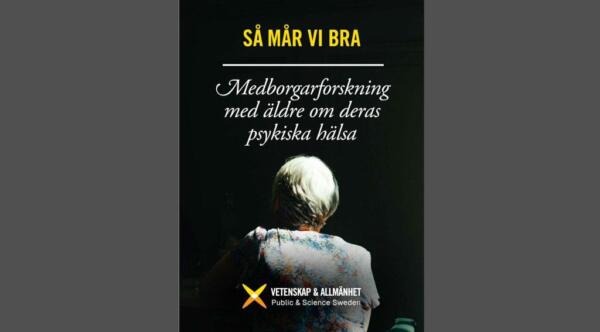
The starting point of “How do older people feel good?” was that discussions about older people’s mental health are too often shaped by preconceived notions about older adults as a group, as well as assumptions about what mental ill health is and who can be affected. In addition, there is a tendency to focus more on older people’s physical health than on their mental well-being. The consequence is that mental health in older age risks being overlooked – despite the fact that this is the age group with the highest proportion of people receiving medication for depression.
The aim of the project has been to highlight older people’s own voices on what matters for mental health in later life. The project began with focus group discussions and science cafés in autumn 2024, where researchers, practitioners, and older individuals met in dialogue about mental health in ageing. Based on the perspectives and topics raised, questions were formulated for the collection of personal stories, which took place in autumn 2025.
In total, more than 100 older individuals participated, with all regions of Sweden represented in the material. Anyone aged 65 or older could participate, and all stories were submitted anonymously. This report presents the results of the analysis conducted in winter 2026, in dialogue with a reference group consisting of researchers, older individuals, and representatives from civil society organisations.
Study results
Examples of prominent themes in participants’ stories included:
- the importance of an active everyday life for well-being
- good relationships with loved ones
- feeling included and valued in broader social contexts
- having influence over one’s time and commitments.
Two themes given particular attention in the analysis were physical activity and anxiety about societal developments and global conditions. These themes were examined in relation to contemporary individualistic messages about taking responsibility for one’s health, how worry manifests differently across life stages, and the fact that we are living in a time of major geopolitical change.
A common feature across these themes is a non-collective framing, expressed either through a focus on one’s own body or a sense of resignation toward the broader societal context.
The study suggests that there may be value in giving older people more opportunities to engage collectively and influence issues they care about and are affected by.
The project in numbers
- 118 people across the country submitted their stories
- All regions of Sweden were represented
- Significantly more women than men participated. Around 85% of the stories were from women
- The “younger old” were clearly overrepresented. About 50% were under 70, and only 5% were over 85.
“How do older people feel good?” was carried out as part of the EU project RE-MEND, in which Public & Science Sweden is collaborating with researchers and universities across Europe to develop new knowledge on preventing mental ill health. The project also served as the 2025 annual ForskarFredag Citizen Science project as part of Sweden’s activities within European Researchers’ Night.
Created: 06 May 2026
Last edited: 06 October 2026