Tetris-inspired research wins Sweden’s top science communication competition
Anan Ashrabi Ananno from Linköping University has won the 2026 Researchers’ Grand Prix, Sweden’s leading science communication competition. Using Tetris to explain the mathematics of optimisation, he impressed both the audience and an expert jury with his four-minute presentation on how algorithms and robotics can be used to pack pallets more efficiently.
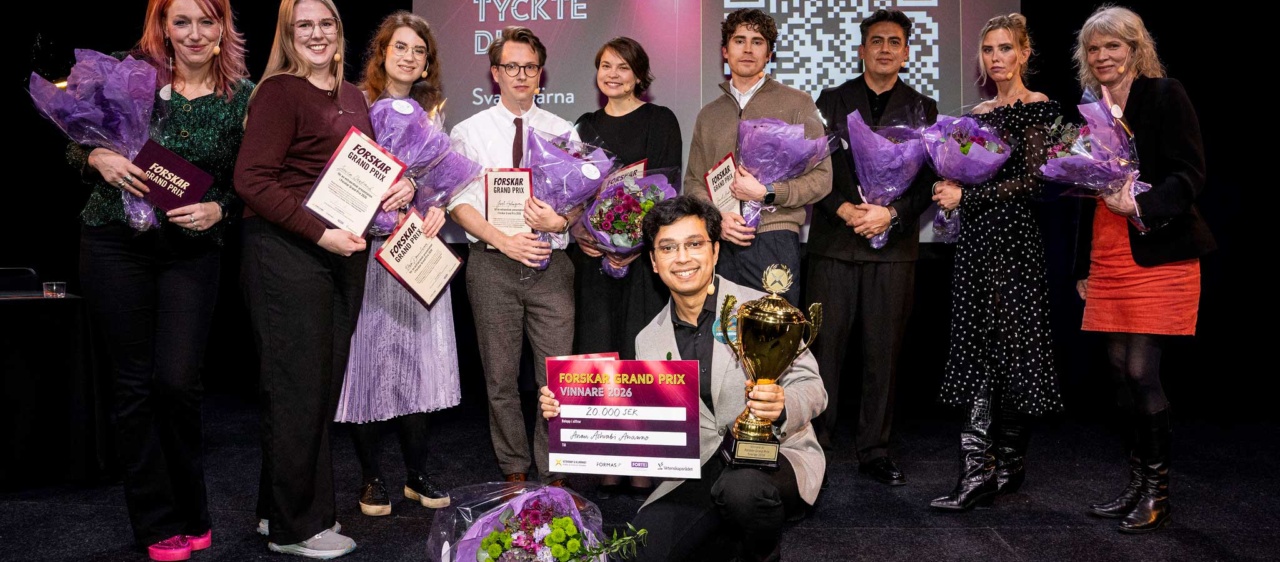
Host Josefin Johansson with finalists Jessica Wesstrand (Mälardalen University), Elsa Danielsson (Chalmers University of Technology), Joel Holmgren (Malmö University), Inta Gribonika (Lund University), winner Anan Ashrabi Ananno (Linköping University) and Daniel Andersson (Karolinska Institutet), alongside jury members Victor Galaz, Nanna Olasdotter Hallberg and Maria Gunther. Photo: Philip Kangas.
How do you turn years of complex research into a captivating four-minute presentation? That is the challenge facing researchers competing in the Researchers’ Grand Prix, where clarity, creativity and the ability to engage an audience are just as important as the research itself.
This year’s final took place at Kulturhuset in Stockholm on 17 November, bringing together six researchers from universities across Sweden. Their presentations covered subjects ranging from criminal investigations and heart diagnostics to needle-free vaccines, communication within organisations and microscopic motors.
The winning presentation focused on optimisation: how mathematics and algorithms can help robots find the most efficient way to pack goods onto pallets. Anan Ashrabi Ananno compared the challenge to playing Tetris in three dimensions, but with additional constraints such as weight, stability and how easily robots can handle and position objects. Finding better packing solutions can reduce wasted space and make industrial production and transport more efficient.
It felt incredible when students came up to me afterwards and asked about my research and how it can be used.
“I’ve never been so happy in my life!” said Ananno after being announced as the winner.
“It felt incredible when students came up to me afterwards and asked about my research and how it can be used. I loved mathematics as a child and fell in love with optimisation when I realised what a powerful tool it is.”
Inspiring the next generation
More than 400 upper-secondary school students attended the final in Stockholm, while almost 800 people followed the competition online. Both the audience and an expert jury helped decide the winner.
The jury assessed the presentations from three different perspectives. Science editor Maria Gunther from Swedish newspaper Dagens Nyheter focused on how clearly the research was explained. Victor Galaz, Associate Professor of Political Science at the Stockholm Resilience Centre, considered how well the researchers communicated their research questions and methods. Playwright and radio personality Nanna Olasdotter Hallberg evaluated their use of the stage, voice and body language.
The winner’s trophy was presented by Emma Gretzer, Director-General of Formas, the Swedish Research Council for Sustainable Development.
Today we have witnessed something of fundamental importance for the future of research: researchers making new knowledge understandable, relevant and engaging,
“Today we have witnessed something of fundamental importance for the future of research: researchers making new knowledge understandable, relevant and engaging,” said Gretzer.
“Society’s major challenges require not only new knowledge, but also that knowledge is shared, understood and put to use.”
About the Researchers’ Grand Prix
The Researchers’ Grand Prix is Sweden’s largest science communication competition for researchers. Since 2012, the national final has been organised by the non-profit association Public & Science Sweden (Vetenskap & Allmänhet), together with the research councils Formas, Forte and the Swedish Research Council.
The six finalists qualified through regional heats in Gothenburg, Eskilstuna, Stockholm, Linköping and Lund, as well as a national qualifying round held in Uppsala. This year marked the first time a regional competition was held in Linköping.
The Researchers’ Grand Prix is part of ForskarFredag, Sweden’s European Researchers’ Night science festival.
Created: 19 November 2026
Last edited: 19 November 2026